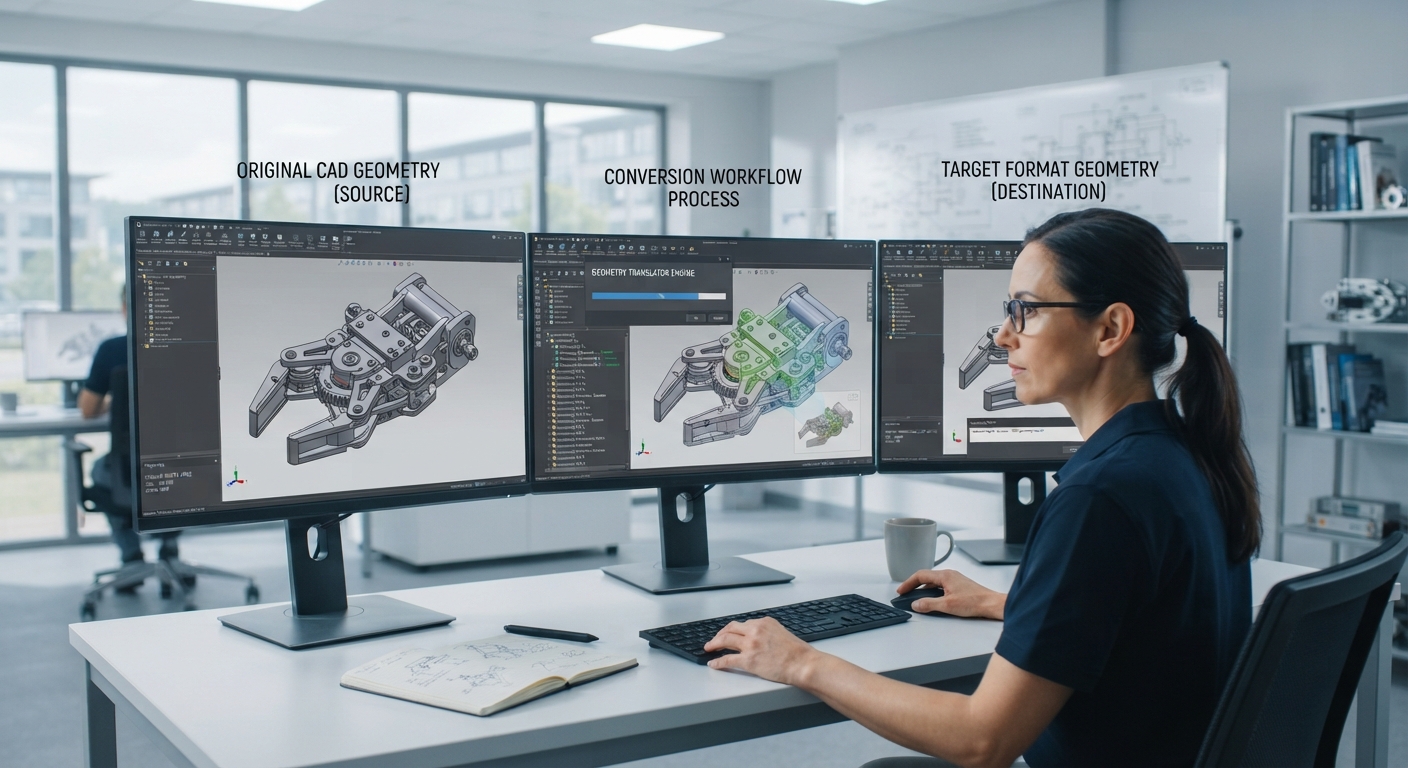
Modern engineering applications use different approaches to create and edit three-dimensional digital models. geometry modelling forms the foundation of these workflows, allowing developers and engineers to represent physical products with digital geometry that can be inspected, modified, analyzed, and transferred between systems. Understanding the differences between solid, surface, and direct modelling can help teams select an approach that fits their particular design requirements.
Each method has a different purpose. Solid modelling focuses on complete volumetric objects, surface modelling provides control over complex external forms, and direct modelling allows users to modify geometry without depending entirely on a predefined feature history. Many modern CAD systems combine these approaches to provide greater flexibility.
Understanding Solid Modelling
Solid modelling represents an object as a complete three-dimensional body with defined boundaries and volume. This makes it particularly useful for mechanical components, machinery, tools, and other products that need precise physical representations.
Developers can build applications that support operations such as creating primitives, combining bodies, subtracting material, and transforming shapes. Boolean operations are especially useful because complex components can often be constructed by combining simpler geometric forms.
Solid models can also provide useful information for downstream processes such as manufacturing, simulation, measurement, and mass-property calculations.
The Role of Surface Modelling
Surface modelling focuses on the shape and appearance of an object's exterior. Unlike a solid, a surface does not necessarily represent an enclosed volume.
This approach is useful when products contain complex curves, smooth transitions, or detailed external forms. Designers can construct surfaces from curves and perform operations such as trimming, extending, joining, and transforming them.
Surface modelling can provide precise control over shapes where traditional solid-based methods may not offer enough flexibility. It is particularly relevant to applications involving products with sophisticated aerodynamic, industrial, or consumer-oriented forms.
What Is Direct Modelling?
Direct modelling provides a flexible way to edit existing geometry. Instead of depending primarily on a parametric feature history, users can manipulate geometric elements such as faces and edges more directly.
This approach can be useful when working with imported CAD models, especially when the original feature history is unavailable. Engineers may be able to move, resize, remove, or modify geometry without reconstructing the entire design process.
Direct modelling can also support quick design changes when users need to experiment with a model or make localized adjustments.
Comparing the Three Approaches
Solid, surface, and direct modelling are not necessarily competing methods. They can serve different stages of an engineering workflow.
Solid modelling is well suited to products that require complete volumetric representations. Surface modelling provides greater control over complex external shapes. Direct modelling offers flexibility when modifying existing geometry or making quick changes.
A modern engineering application may combine all three. For example, a designer could create a component as a solid, develop a complex exterior using surface techniques, and then make final adjustments through direct editing.
Managing Geometric Relationships
Regardless of the modelling method, applications need to manage relationships between geometric elements. Faces, edges, vertices, curves, and surfaces must remain consistent when a model is modified.
Topology plays an important role in this process. When an operation changes the geometry, the application must maintain appropriate connections between the affected elements.
Reliable geometric and topological processing can help prevent inconsistencies that could affect later design or manufacturing operations.
Accuracy and Model Quality
Engineering models often need to meet demanding accuracy requirements. Small geometric problems can become significant when a model is used for manufacturing, simulation, inspection, or data exchange.
Developers should test modelling operations with realistic datasets that include complex surfaces, small features, intersections, and large assemblies. Testing can reveal how reliably a modelling system handles challenging cases.
Performance Considerations
As models become more detailed, performance becomes increasingly important. Large assemblies and complex surfaces can require significant computational resources.
Development teams should evaluate model loading, editing operations, memory usage, and application responsiveness. Realistic engineering datasets provide a better indication of production performance than simple demonstration models.
Choosing a Modelling Strategy
The best modelling strategy depends on the application's objectives. Teams should consider the types of products being designed, the complexity of the geometry, the expected editing workflow, and the downstream uses of the models.
Combining solid, surface, and direct techniques can provide a flexible foundation for modern engineering software. It allows users to choose the most suitable method for a particular modelling task rather than being restricted to one approach.
Conclusion
Solid, surface, and direct modelling each contribute valuable capabilities to modern CAD workflows. Solid modelling provides complete volumetric representations, surface modelling supports sophisticated forms, and direct modelling offers flexible editing of existing geometry.
By combining these techniques with reliable geometric processing, topology management, visualization, and data exchange, engineering applications can support a wide range of design requirements. A thoughtful modelling strategy can help developers create software that handles complex 3D data while giving engineers practical tools for creating and modifying digital products. Choosing 3D Software Components for Engineering Products
#GeometricKernel #C3DModeler #C3DLabs